T again. This was going to be a photo-laden entry about a recent day trip out to the Civil War battlefield at Antietam (or Sharpsburg), Maryland on a warm Thanksgiving weekend, but perhaps first, I thought I might provide a little background on my interest in the war.
I was once upon a time a voracious reader and serious follower of all things related to the American Civil War. I still remember my first Civil War book, Glenn Tucker's High Tide At Gettysburg, which came out in in 1958. It told the story of the Gettysburg campaign from the Confederate perspective. I found a copy of it in a stack of my father's old college books when I was about 12 or 13. I think that particular copy fell apart at some point as I carried it around from place to place. The book is lively written, straightforward, and carries a definite pro-Southern slant. I was hooked, and since then, I have probably read a library's worth of books and visited battlefields from Arkansas to Georgia to Pennsylvania. Over the years, however, my interest has waned a bit. It is in part because those interests have expanded and become more varied (the British in the years leading up to and including World War One is my latest kick), but I would put forth that the larger reason is that everyone and their brother over the past 20 years seems to have written a book about the war (there are some 60,000 books on the Civil War), and there appears to be very little that has not been covered ad nauseum by someone. The internet and the continued discovery of primary sources have been a big part of that, but I point to Ken Burns and his excellent PBS series from the early 1990s for the latest spark. Mr. Burns poignant story with its solid narration, quotes, period music, and memorable photos made Civil War history popular again after it had lost much of its appeal in the aftermath of the civil rights movement and the Vietnam War. Unfortunately, he may have made it too popular. The Civil War became cool again and now it seems every Tom, Dick, and Harry writes on the war, and they write often. Sometimes Tom, Dick and Harry do well; other times, not so well.
Okay, so I'm being a little facetious. Despite the incredible number of books written on our "war between the states," there are some good works still being put out, and while I may not read as much as I once did, I do some favorite authors I would recommend to anyone interested in the subject. It is, after all, a fascinating period to study. New sources continue to be discovered and people are finding new and innovative ways to analyze the war. Indeed, just a few months back, it was announced that census data from the period suggests the total number of casualties from the war was not the 620,000 long thought, but perhaps as many as 850,000 http://opinionator.blogs.nytimes.com/2011/09/20/recounting-the-dead/. Folks, today that would be more than 6 million dead. While a goodly percentage of those deaths were from disease, it does go to show we Americans certainly know how to kill each other if need be. Perhaps that is one of the primary reasons so many of us continue to buy those books.
Speaking of books, I was about to mention a few to consider before I went off on that slight tangent. To make it easier, let me break them down into a few categories: First, for an overview of the war, Bruce Catton's series from the 1960s, which can be found in paperback in just about any used book store or on Amazon for a buck or two, and James McPherson's Battle Cry of Freedom, which won for him a Pulitzer Prize. McPherson is recognized as one of, if not the premier Civil War author out there today, penning a number of studies ranging from Lincoln to the lives of the soldiers to slavery to individual battles. I seem to recall him writing somewhere that he was inspired by Mr. Catton. There is also Shelby Foote's massive 3-volume history of the war (The Civil War: A Narrative). Mr. Foote, who died several years ago, became famous on the Ken Burns PBS series you might recall. His narrative is a good read, but not as scholarly McPherson's work and lean a bit towards the Southern side of the conflict. It is also, by the way, over 2,000 pages long.
For campaigns and battles in the eastern theater of the war, I would recommend several authors: At the top of the list would be Stephen Sears. You cannot go wrong with his books To the Gates of Richmond (the Seven Days Campaign), A Landscape Turned Red (Battle of Antietam), Chancellorsville, and Gettysburg. He is a fantastic storyteller and is certain to keep your interest even if you don't really care for military history, particularly with Landscape. These were pivotal battles in the eastern theater of the war in 1862 and 1863, so there are many books on them (especially Gettysburg); I would rate these as the best of the lot, probably because they tell the stories effectively without getting too technical and manage to weave in the larger picture for the reader. The Shenandoah Valley also was an important area of conflict in the east, particularly in 1862 and 1864. For the 1862 affair, check out Peter Cozzen's Shenandoah 1862: Stonewall Jackson's Valley Campaign or Russ Mohney's Stonewall in the Valley, which covers the same campaign. If you read both, you will get a different perspective because Cozzens is a little less enamored with Thomas Jackson than Mohney and many other historians. I think his research is better, although Mohney's book may be an easier read of this famous campaign, which is still studied by various militaries. For the 1864 Valley campaign, I like Jeffry Wert's From Winchester to Cedar Creek. For the other major 1864 campaign in the east, the epic struggle between Robert E. Lee and Ulysses S. Grant, try Gordon Rhea's series, which looks at the battles of the Wilderness, Spotsylvania, the North Anna River, and Cold Harbor. These are a bit more on the real military history side of writing, but are well written. Last, being a North Carolinian, I like Rod Gragg's study of the Fort Fisher Campaign (Confederate Goliath), which closed the Confederacy's last port of Wilmington, NC in 1865.
The western theater has over the past 20-25 years seen an explosion of battle and campaign studies, many of which are quite good. This theater of the war was long neglected, largely because most people were more interested in reading about the east and its more famous characters...the Robert E. Lees, Stonewall Jacksons, and George B. McClellans...as well as more well-known battles (Gettysburg, Antietam, Chancellorsville, Bull Run, the Shenandoah Valley, etc). The more you read of the western theater, however, the more you will understand it was where the war was ultimately won or lost depending on your perspective. While perhaps a little too detailed for many readers, Peter Cozzens has written a number of well-received books on some of the key battles and campaigns in the west, including Stone's River (No Better Place to Die), Iuka and Corinth (Darkest Days of the War), Chickamauga (This Terrible Sound), and Chattanooga (Shipwreck of their Hopes). The Chickamauga book is probably my favorite of the lot. It is a well-researched study of a confusing and bloody battle south of Chattanooga in the woods of north Georgia. It also provides a platform for a fascinating study of the relations amongst generals in battle on both the Union and Confederate sides. In short, it is a bit of bad soap opera in the midst of two days of fighting that led to some 35,000 casualties. For a look at William Tecumseh Sherman's pivotal Atlanta campaign, check out Albert Castel's Decision in the West. Exhaustively researched, tightly written, told in the present tense (an unusual, but very effective technique I thought), and offering some occasionally controversial analysis, it is also one of my favorite campaign books. Last, but certainly not least, I would offer up a book I have mentioned before: Wiley Sword's Embrace an Angry Wind: Spring Hill, Franklin, and Nashville. Some of Sword's analysis is contentious, but the book reads like a novel. Highly recommended.
There are a number of other campaign studies I might recommend, including something for the Trans-Mississippi theater, but this is probably a long enough list. And, I haven't even talked about any biographies, books covering the homefront, politics, individual soldiers and units, or grand strategy. That might take several more pages, and by then, I would certainly bore you completely to tears. A few short thoughts though. If you are interested in the common soldier, Bell Wiley's The Life of Billy Yank and The Life of Johnny Reb, although first published in the 1940s, are both still considered classics. James McPherson tries to get at why the soldiers fought in For Cause and Comrades. Embattled Courage by Gerald Linderman looks at how the stark and deadly realities of combat changed how soldiers viewed combat, comrades, the enemy, and civilians. The last few I will mention have to do with the rather widespread (and often little-known) "war within a war" in the South, starting with a short book I read in graduate school by Phillip Paludan called Victims: A True Story of the Civil War. It is about an incident in the mountains of North Carolina where Confederate soldiers, in a frustrating hunt for deserters and Unionists, executed 13 men and boys. It is a fascinating mix of social and military history. William Trotter's Bushwackers: The Civil War in the North Carolina Mountains gives a lively account of the whole story about what went on in western North Carolina during the war without getting too bogged down in the details. A hint: It was not pretty, but not nearly as bad as what went on in Missouri and Kansas. For a taste of that unsavory affair, check out Thomas Goodrich and start with Black Flag: Guerrilla Warfare on the Western Border, 1861-65. I am still looking for a good book on Civil War grand strategy, but I hear an Army War College faculty member, Dr. Carol Reardon, has one coming out sometime next year, so we shall see....
Okay. I think with that I will stop. Stay tuned for some visits to Civil War battlefields.

Encapsulating the diverse and enduring interests of H&T. Keep reading and you'll figure it out.
Friday, December 9, 2011


Sunday, November 20, 2011
Being generally about food
This post is going to be primarily gastronomical in nature. Given that we are headed into Thanksgiving week, I don't think this is inappropriate.
This past week the entire Army War College class went to New York City. Spouses were encouraged to accompany their students and although MP was not really in a state where she could be left, I boarded her at the vet and joined T for two of his four days up there. We won't talk about her experience - suffice to say she is home and hopefully past the trauma.
I arrived in Manhattan on a rainy Wednesday, dropped my bag at the hotel and within 10 minutes was on a Bronx bound commuter train with T in tow. We were headed to the Fordham station, a short walk away from that gastronomical wonderland known as Arthur Avenue. Billed as the "Little Italy in the Bronx," it is a compact neighborhood of Italian bakeries, grocery stores, restaurants and butchers. There are a few touristy shops, mainly new places that have popped up since the first visit I made up to Arthur Avenue when I was living in NYC as a graduate student at Columbia.
I have my routine down pat now. Eat at Dominick's, buy Sopressata sausage at the Calabria Pork store, eat pastries and drink tea at Egidio's Pastry Shop and wander through the municipal market. When I lived in NYC I would go home with a backpack full of perishables - vegetables, fresh homemade raviolis, fresh bread, succulent lamb chops, etc. However, now that I travel there and back as a visitor I have to limit myself to items that will not spoil during my stay.
The meal at Dominick's was probably one of the best I have ever had there. The restaurant was relatively empty, it being 1500 on a Wednesday. Still there were a fair number of people lined up shoulder to shoulder on the long communal tables. A large group of business men dominated the dining room, eating a late lunch/early supper. They had plates mounded high with mussels in marinara sauce. I couldn't resist this. However, first we started out with the first dish I ever ate at Dominick's, the artichoke braised in butter and stuffed with Sopressata sausage and breadcrumbs. I had it the first time with my good friend Michelle. It was as good as I remembered it to be and I wished Michelle had been there with me to share it again. It was so good in fact that it was all but gone before I remembered to take a photo.

The main course was grilled lamb chops with fries, braised broccoli rabe and those amazing, garlicky mussels in marinara. Excellent as always. I can't wait to get back up there.

Dominick's is on the main drag in Arthur Avenue, directly across from the Calabria Pork Store. You can't miss it. Or should I say, you shouldn't miss it.

As I said, across the street from Dominick's is the store which draws me back to Arthur Avenue again and again. The veritable Calabria Pork Store.

This store specializes in cured pork, cheeses, olives and some fresh sausage. But mainly it is known for its cured pork.

In fact, the pork lures you in from the street and then all but assaults you with its musky aroma the second you walk into the darkened interior. It isn't that the lights are turned down. In fact, they are turned up all the way. The reason for the darkened interior is the fact that sausages hang from the ceiling to cure, turning the entire store into a sort of meat cave wonderland.

I don't think I can say much else besides the fact that I love the Calabria Pork Store and in particular, their spicy Sopressata. My bag will always be heavy on the walk back to the metro/train station from Arthur Avenue because it is inevitably full of Sopressata from the Calabria Pork Store. It is the one time I really don't mind lugging heavy shopping bags.
After loading up with enough spicy Sopressata to feed a small army, we went over and down one block to the Egidio Pastry Shop.

Here we fortified ourselves with caffeine and sugar. Specifically with fresh canollis and chocolate cream puffs.

Egidio's is about to celebrate their 100th anniversary. I am not surprised. With pastries as delightful and fresh as theirs, and window displays that are enticing, nostalgic and mouth-watering I am sure they will be around for another 100 years at least.

My Mom turned me on to Arthur Avenue. She had read about it in the March 2002 Saveur magazine. I remember making that long trek up there through the Bronx on train then bus for the first time wondering if it was going to be worth all the trouble. It was. I have been back more times than I can remember and even considered getting an apartment there when I was in school in Manhattan but decided against it, due less to the distance to campus than to the fact that I would probably have put on five pounds a week if I lived up there. Here is that article:
http://www.saveur.com/article/Travels/To-Market-with-Papa
There is also a great guide/cookbook on Arthur Avenue by Amy Volkwein:

My advice to anyone traveling to New York City hungry for Italian food is to steer clear of Little Italy in lower Manhattan and make straight for Arthur Avenue. Yes, it will take longer, but it will be a trip you will remember for the rest of your life.
Back at home now I did a fair amount of cooking today. Part of it is gearing up for Thanksgiving. I am cooking for three men and would like to not be run ragged on Thursday. Therefore I am starting early. Today I mixed the homemade sausage for stuffing, peeled and minced three heads of garlic, cleaned and prepped two bags of Brussels sprouts, made bread crumbs from stale homemade bread and roasted and prepped a spaghetti squash. Tomorrow I'll make the vegetable and sausage mix for the stuffing and perhaps start to prep the spaghetti squash souffle.

Spaghetti squash is such an under-appreciated vegetable. I am going to modify an old recipe I have for corn souffle and see how it turns out. I'll let you know.
The other thing I did in the kitchen tonight was try two recipes from a new cookbook, perhaps the very best hostess gift I have ever received. Last weekend I had some women I met on the internet over for a stitcher's get-together. One of the women was in town from California and she brought me a fantastic Indian cookbook written by a member of India's Parsi community. Parsi's are the descendants of the Zoroastrians who migrated to India from Persia long ago. The food in the book seems to be a marvelous mix of Persian and Indian cooking, with a California twist. The book is by Niloufer Ichaporia King and is called My Bombay Kitchen: Traditional and Modern Parsi Home Cooking. It is wonderful.

I made two dishes from the cookbook tonight - the Thanksgiving Brussels sprouts and the cardamom cake. The Thanksgiving Brussels sprouts are simple yet tedious. First you must separate the leaves of the sprouts. Since I was cleaning two bags of sprouts for Thanksgiving dinner, where I plan to saute them with butter, lemon and oregano (in the style of NYC's Casa Mono restaurant), I decided to go ahead and trim the outer leaves for use tonight. I ended up with a colander full of tiny green leaves, as well as more than enough for dinner on Thursday. From this point on, the preparation is easy.

Mustard seeds in hot oil with ginger, some chili and salt. I added some garlic in for good measure. The trick I think is to toss the Brussels sprout leaves until they are just tender, being careful not to over do them. I think I got them just perfect.

I ate them with couscous, a stuffed pork chop and a Côtes du Rhône red wine. They were by far the highlight of the meal.


For dessert I made the cardamom cake, which calls for an entire tablespoon of crushed cardamom seeds.
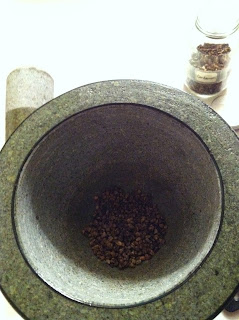
The recipe says to use a nine-inch spring form pan, but I chose to use three six-inch pans instead, so I could share the cakes. First the pans get dusted with sugar and almonds.

Then the simple batter is prepared, with help from the standing mixer.
 Divided into three, with bits of cardamom dotting the creamy batter.

It had to be tasted directly out of the oven, the smell was so incredibly divine. A little embarrassing that I didn't even get a photo in before the tasting.

This cake was lovely and will definitely be made again. However, I found it a tad bit too sweet. Next time I am going to reduce the sugar and may substitute the almonds with a generous layer of crushed pistachios.
In the meantime, I discovered that serving the cake with plain (unsweetened) Greek yogurt cuts the sweetness and adds a fantastic complexity to the cake.

Good thing I went running today.
Thank you to Veena for this amazing cookbook! I am not done experimenting and it is going to bring me many afternoons of pleasure in the kitchen.
This past week the entire Army War College class went to New York City. Spouses were encouraged to accompany their students and although MP was not really in a state where she could be left, I boarded her at the vet and joined T for two of his four days up there. We won't talk about her experience - suffice to say she is home and hopefully past the trauma.
I arrived in Manhattan on a rainy Wednesday, dropped my bag at the hotel and within 10 minutes was on a Bronx bound commuter train with T in tow. We were headed to the Fordham station, a short walk away from that gastronomical wonderland known as Arthur Avenue. Billed as the "Little Italy in the Bronx," it is a compact neighborhood of Italian bakeries, grocery stores, restaurants and butchers. There are a few touristy shops, mainly new places that have popped up since the first visit I made up to Arthur Avenue when I was living in NYC as a graduate student at Columbia.
I have my routine down pat now. Eat at Dominick's, buy Sopressata sausage at the Calabria Pork store, eat pastries and drink tea at Egidio's Pastry Shop and wander through the municipal market. When I lived in NYC I would go home with a backpack full of perishables - vegetables, fresh homemade raviolis, fresh bread, succulent lamb chops, etc. However, now that I travel there and back as a visitor I have to limit myself to items that will not spoil during my stay.
The meal at Dominick's was probably one of the best I have ever had there. The restaurant was relatively empty, it being 1500 on a Wednesday. Still there were a fair number of people lined up shoulder to shoulder on the long communal tables. A large group of business men dominated the dining room, eating a late lunch/early supper. They had plates mounded high with mussels in marinara sauce. I couldn't resist this. However, first we started out with the first dish I ever ate at Dominick's, the artichoke braised in butter and stuffed with Sopressata sausage and breadcrumbs. I had it the first time with my good friend Michelle. It was as good as I remembered it to be and I wished Michelle had been there with me to share it again. It was so good in fact that it was all but gone before I remembered to take a photo.

The main course was grilled lamb chops with fries, braised broccoli rabe and those amazing, garlicky mussels in marinara. Excellent as always. I can't wait to get back up there.

Dominick's is on the main drag in Arthur Avenue, directly across from the Calabria Pork Store. You can't miss it. Or should I say, you shouldn't miss it.

As I said, across the street from Dominick's is the store which draws me back to Arthur Avenue again and again. The veritable Calabria Pork Store.

This store specializes in cured pork, cheeses, olives and some fresh sausage. But mainly it is known for its cured pork.

In fact, the pork lures you in from the street and then all but assaults you with its musky aroma the second you walk into the darkened interior. It isn't that the lights are turned down. In fact, they are turned up all the way. The reason for the darkened interior is the fact that sausages hang from the ceiling to cure, turning the entire store into a sort of meat cave wonderland.

I don't think I can say much else besides the fact that I love the Calabria Pork Store and in particular, their spicy Sopressata. My bag will always be heavy on the walk back to the metro/train station from Arthur Avenue because it is inevitably full of Sopressata from the Calabria Pork Store. It is the one time I really don't mind lugging heavy shopping bags.
After loading up with enough spicy Sopressata to feed a small army, we went over and down one block to the Egidio Pastry Shop.

Here we fortified ourselves with caffeine and sugar. Specifically with fresh canollis and chocolate cream puffs.

Egidio's is about to celebrate their 100th anniversary. I am not surprised. With pastries as delightful and fresh as theirs, and window displays that are enticing, nostalgic and mouth-watering I am sure they will be around for another 100 years at least.

My Mom turned me on to Arthur Avenue. She had read about it in the March 2002 Saveur magazine. I remember making that long trek up there through the Bronx on train then bus for the first time wondering if it was going to be worth all the trouble. It was. I have been back more times than I can remember and even considered getting an apartment there when I was in school in Manhattan but decided against it, due less to the distance to campus than to the fact that I would probably have put on five pounds a week if I lived up there. Here is that article:
http://www.saveur.com/article/Travels/To-Market-with-Papa
There is also a great guide/cookbook on Arthur Avenue by Amy Volkwein:

My advice to anyone traveling to New York City hungry for Italian food is to steer clear of Little Italy in lower Manhattan and make straight for Arthur Avenue. Yes, it will take longer, but it will be a trip you will remember for the rest of your life.
Back at home now I did a fair amount of cooking today. Part of it is gearing up for Thanksgiving. I am cooking for three men and would like to not be run ragged on Thursday. Therefore I am starting early. Today I mixed the homemade sausage for stuffing, peeled and minced three heads of garlic, cleaned and prepped two bags of Brussels sprouts, made bread crumbs from stale homemade bread and roasted and prepped a spaghetti squash. Tomorrow I'll make the vegetable and sausage mix for the stuffing and perhaps start to prep the spaghetti squash souffle.

Spaghetti squash is such an under-appreciated vegetable. I am going to modify an old recipe I have for corn souffle and see how it turns out. I'll let you know.
The other thing I did in the kitchen tonight was try two recipes from a new cookbook, perhaps the very best hostess gift I have ever received. Last weekend I had some women I met on the internet over for a stitcher's get-together. One of the women was in town from California and she brought me a fantastic Indian cookbook written by a member of India's Parsi community. Parsi's are the descendants of the Zoroastrians who migrated to India from Persia long ago. The food in the book seems to be a marvelous mix of Persian and Indian cooking, with a California twist. The book is by Niloufer Ichaporia King and is called My Bombay Kitchen: Traditional and Modern Parsi Home Cooking. It is wonderful.
I made two dishes from the cookbook tonight - the Thanksgiving Brussels sprouts and the cardamom cake. The Thanksgiving Brussels sprouts are simple yet tedious. First you must separate the leaves of the sprouts. Since I was cleaning two bags of sprouts for Thanksgiving dinner, where I plan to saute them with butter, lemon and oregano (in the style of NYC's Casa Mono restaurant), I decided to go ahead and trim the outer leaves for use tonight. I ended up with a colander full of tiny green leaves, as well as more than enough for dinner on Thursday. From this point on, the preparation is easy.

Mustard seeds in hot oil with ginger, some chili and salt. I added some garlic in for good measure. The trick I think is to toss the Brussels sprout leaves until they are just tender, being careful not to over do them. I think I got them just perfect.

I ate them with couscous, a stuffed pork chop and a Côtes du Rhône red wine. They were by far the highlight of the meal.


For dessert I made the cardamom cake, which calls for an entire tablespoon of crushed cardamom seeds.

The recipe says to use a nine-inch spring form pan, but I chose to use three six-inch pans instead, so I could share the cakes. First the pans get dusted with sugar and almonds.

Then the simple batter is prepared, with help from the standing mixer.


It had to be tasted directly out of the oven, the smell was so incredibly divine. A little embarrassing that I didn't even get a photo in before the tasting.

This cake was lovely and will definitely be made again. However, I found it a tad bit too sweet. Next time I am going to reduce the sugar and may substitute the almonds with a generous layer of crushed pistachios.
In the meantime, I discovered that serving the cake with plain (unsweetened) Greek yogurt cuts the sweetness and adds a fantastic complexity to the cake.

Good thing I went running today.
Thank you to Veena for this amazing cookbook! I am not done experimenting and it is going to bring me many afternoons of pleasure in the kitchen.
Saturday, November 12, 2011
US Army War College and the Army Heritage and Education Center
It has been a while, I know. As H noted in a recent post, I am attending the Army War College in Carlisle, PA for 10 months. The curriculum keeps me busy, and I have let time slip by. It has been nearly 20 years since I attended any kind of school, so academic work has been not only a bit difficult to adjust to, but it has also been time-consuming. Keeping up with the reading takes a good chunk of the day, and then there are the papers. I cannot complain though. It is an opportunity to get a second masters degree and comes at government--taxpayer's--expense. I hope to make the investment a worthy one. One of the primary reasons I wanted to go is to both take advantage of my interest in military history and to improve my use of it in the context of current events. I think my current study plan fulfills that desire.
The first half of the school year focuses on "core" courses; strategic thinking, the theory of war and strategy, strategic leadership, national security policy and strategy, and theater strategy and campaign planning. Later in the year, we will work through electives, which I am looking forward to since the electives curriculum is quite broad and offers a great deal of flexibility, particularly in history courses. I am currently in the national security and policy block, which is a bit of a bore since most of the curriculum reflects the world--the processes of Washington, DC--I have been working in for the last 15 years or so. Thus far, I have found the theory of war and strategy block to be the most interesting. The readings were engaging, largely because they were historically focused, and the chief seminar facilitator (a civilian historian and a professor at a civilian university) was the most competent instructor thus far. One of the purposes of the War College is to get US Army colonels and senior civilian officers to think at the "strategic" level, as opposed to the tactical and operational level. In that endeavor, I think the college is largely successful. The quality of instruction, however, is a bit uneven, probably because the college in part seems to be a refuge for late-career and retired colonels.
I think it is obvious from this blog that my interest in military history is largely at the tactical and operational level, but the theory of war and strategy block in particular has inspired me to take my reading to a higher level; and by that I mean historical works that focus on strategic decision making. I have a new respect for the Athenian historian Thucydides (read The Landmark Thucydides) and books like The Making of Strategy: Rulers, States, and War (Williamson Murray, ed) and Bernard Brodie's War and Politics, as well as works by Colin Gray and Paul Kennedy. Murray's Strategy has an exceptional chapter by John Gooch on how the British managed its far-flung empire in the years before WW1 when it was coming to the realization that it was over-extended ("The Weary Titan: Strategy and Policy in Great Britain, 1890-1914"). That entry might have some relevance for US strategists today. For those of you who are more into the theory of war, I think Clausewitz still applies, despite his detractors. Clausewitz is tough to read, so if you want to get a taste of him without struggling through On War, try Michael Howard's Clausewitz: A Very Short Introduction for a start. And if you cannot stomach Clausewitz at all, don't forget Sun Tzu or Henri Jomini. Otherwise, just stick with Thucydides. He was a historian, not a theorist, but the aspects of war he wrote about some 2,500 years ago, still apply today.
But I digress. Nearby the War College is the Army Heritage and Education Center. It is open to the public and well worth your time. It offers three venues for use. The first of which, the archives, are impressive, particularly for anyone interested in writing on the particulars of the US Army. Their motto is something along the lines of "Telling the Army story, one soldier at a time." If you want to check out their holdings, go here: http://www.ahco.army.mil/site/index.jsp. The Center also offers a couple of indoor displays. Currently, it has one on General of the Army Omar Bradley and, in honor of the 150th anniversary of the start of the American Civil War, a display on the soldiers of the conflict (see the photos below). Last, there is a permanent outdoor display called The Heritage Trail. It is about a mile walk through a number of displays telling the story of the American army and soldier from the Revolutionary War through our most recent conflicts. I've include a few photographs below, but you can also access the Heritage Trail through the AHEC's interactive website here: http://www.carlisle.army.mil/AHEC/AHM/heritage.cfm.

The first half of the school year focuses on "core" courses; strategic thinking, the theory of war and strategy, strategic leadership, national security policy and strategy, and theater strategy and campaign planning. Later in the year, we will work through electives, which I am looking forward to since the electives curriculum is quite broad and offers a great deal of flexibility, particularly in history courses. I am currently in the national security and policy block, which is a bit of a bore since most of the curriculum reflects the world--the processes of Washington, DC--I have been working in for the last 15 years or so. Thus far, I have found the theory of war and strategy block to be the most interesting. The readings were engaging, largely because they were historically focused, and the chief seminar facilitator (a civilian historian and a professor at a civilian university) was the most competent instructor thus far. One of the purposes of the War College is to get US Army colonels and senior civilian officers to think at the "strategic" level, as opposed to the tactical and operational level. In that endeavor, I think the college is largely successful. The quality of instruction, however, is a bit uneven, probably because the college in part seems to be a refuge for late-career and retired colonels.
I think it is obvious from this blog that my interest in military history is largely at the tactical and operational level, but the theory of war and strategy block in particular has inspired me to take my reading to a higher level; and by that I mean historical works that focus on strategic decision making. I have a new respect for the Athenian historian Thucydides (read The Landmark Thucydides) and books like The Making of Strategy: Rulers, States, and War (Williamson Murray, ed) and Bernard Brodie's War and Politics, as well as works by Colin Gray and Paul Kennedy. Murray's Strategy has an exceptional chapter by John Gooch on how the British managed its far-flung empire in the years before WW1 when it was coming to the realization that it was over-extended ("The Weary Titan: Strategy and Policy in Great Britain, 1890-1914"). That entry might have some relevance for US strategists today. For those of you who are more into the theory of war, I think Clausewitz still applies, despite his detractors. Clausewitz is tough to read, so if you want to get a taste of him without struggling through On War, try Michael Howard's Clausewitz: A Very Short Introduction for a start. And if you cannot stomach Clausewitz at all, don't forget Sun Tzu or Henri Jomini. Otherwise, just stick with Thucydides. He was a historian, not a theorist, but the aspects of war he wrote about some 2,500 years ago, still apply today.
But I digress. Nearby the War College is the Army Heritage and Education Center. It is open to the public and well worth your time. It offers three venues for use. The first of which, the archives, are impressive, particularly for anyone interested in writing on the particulars of the US Army. Their motto is something along the lines of "Telling the Army story, one soldier at a time." If you want to check out their holdings, go here: http://www.ahco.army.mil/site/index.jsp. The Center also offers a couple of indoor displays. Currently, it has one on General of the Army Omar Bradley and, in honor of the 150th anniversary of the start of the American Civil War, a display on the soldiers of the conflict (see the photos below). Last, there is a permanent outdoor display called The Heritage Trail. It is about a mile walk through a number of displays telling the story of the American army and soldier from the Revolutionary War through our most recent conflicts. I've include a few photographs below, but you can also access the Heritage Trail through the AHEC's interactive website here: http://www.carlisle.army.mil/AHEC/AHM/heritage.cfm.
 |
| An impressive display of small arms. |

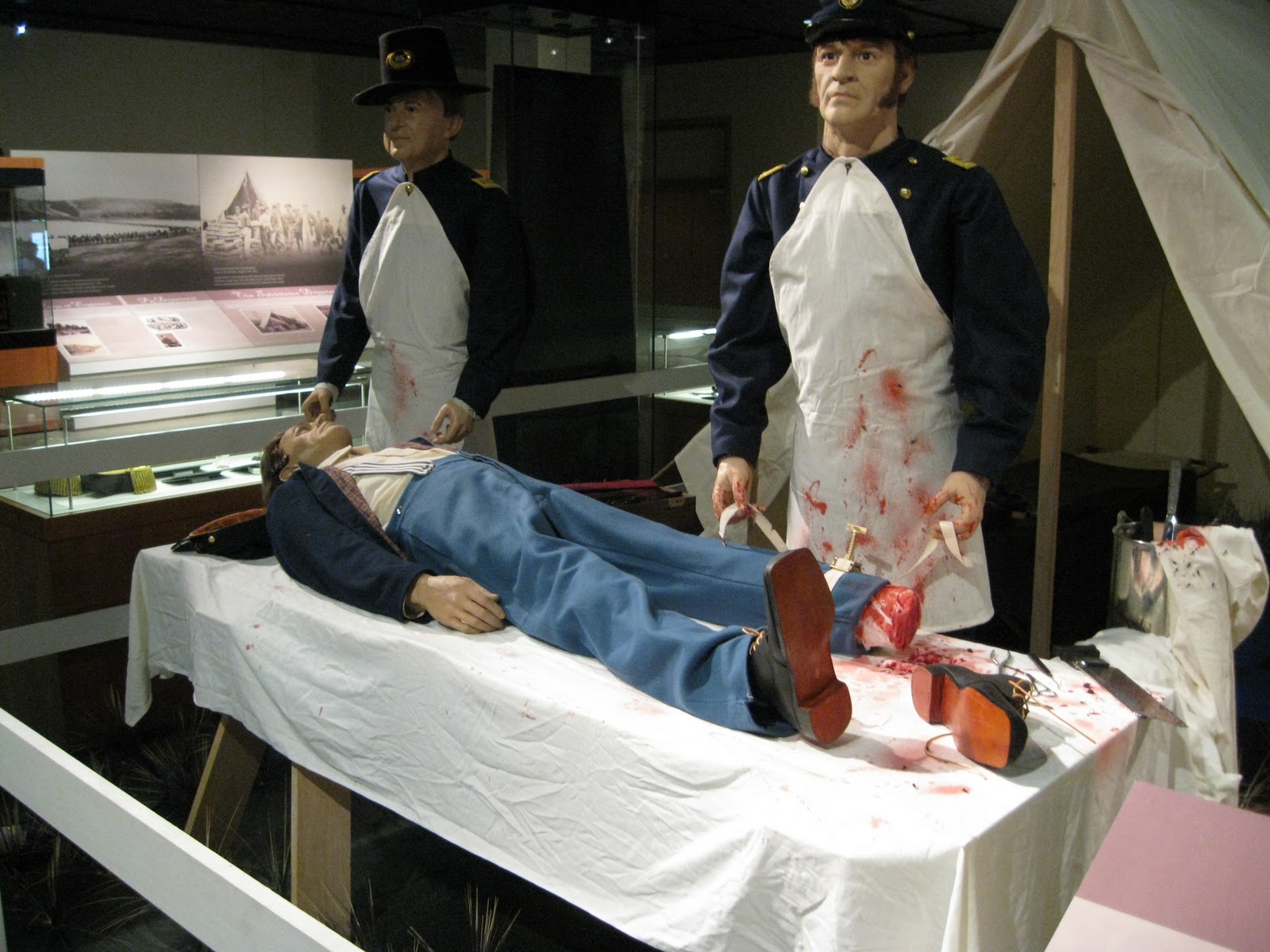 |
| Kudos for showing the heavy and gruesome costs of war. |
 |
| The AHEC is a fairly large place. This particular building holds the archives. |
 |
| The M4 Sherman. Mainstay of the US Army's armor forces in World War 2. |
 |
| One of the things I liked about the walk are these vignettes of individual acts of heroism. This one describes the capture of a Confederate battle flag during the Battle of Antietam in 1862. |
 |
| A 12-lb "Napoleon" smoothbore cannon from the Civil War. |
 |
| There are a few monuments to individual units that have served in America's wars. The 80th "Blue Ridge Boys" Division, comprised of draftees from Pennsylvania, West Virginia, and western Virginia, fought in World War One. It suffered heavy losses in the Meuse-Argonne Campaign. Curiously, the monument notes the elements of the divisions has participated in military operations since since 2001. |
 |
| The M60 tank. Mainstay of US armor forces prior the introduction of the M1 Abrams in the 1980s. I am a former tanker, having served on M60A3s, M1s, and M1A1s, so I always find myself drawn to these tank displays. |
 |
| M60s crossing the Mass River in the Netherlands during an exercise in the 1980s. |
 |
| The AH-1 Cobra attack helicopter. First introduced during the Vietnam War, it is still used by many military forces, including the US Marine Corps. |
 |
| The UH-1 "Huey" helicopter, forever identified with America's misadventure in Vietnam. |
 |
| An 8-inch howitzer. These were introduced in World War 2 and served in the US Army until the 1990s. Having seen these action, I can attest to their power. This one could use a visit from an air compressor. |
 |
| An 8-inch howitzer in action in Korea, 1951. |
 |
| A replica of Redoubt Number 10, one of the British forts at Yorktown seized towards the end of the siege in 1781. |
 |
| The interior. |
 |
| One of the displays on the Heritage Trail is a firebase representing the war in Vietnam. Fire Support Bases (or just "firebases") were often used in the Vietnam War for artillery support. Usually, the artillery used were 105mm howitzers, like this one, or 155mm howitzers. |
 |
| A 105 and its crew in action. |
 |
| A photo of "Buffalo" soldiers from the Spanish-American War of 1898. These troopers are from the 9th Cavalry Regiment around the time of the fighting for the San Juan heights in Cuba. Before the desegregation of the Army during the Korean War, the 9th and 10th Cavalry regiments, as well as the 24th and 25th Infantry regiments, were comprised of black soldiers with mostly white officers. |
 |
| Entrance to a replica of a WW1 German bunker. |
 |
| American dispatch runners in the Argonne, October 1918. |
 |
| I think the WW1 trench system is probably the most impressive part of the Heritage Walk. |
 |
| Complete with barbed wire, the nemesis of infantry during WW1. |
 |
| Designed from photographs of WW1 trenches. |
 |
| Machine guns used by American soldiers during WW1. From left to right: A Hotchkiss, Browning, and Vickers. One that is missing is the Chauchat, a French-made machine gun notorious for its poor performance. The machine gun in WW1 was a devastating weapon. For an idea of its impact, read The Social History of the Machine Gun by John Ellis. Of course, read any good book on the carnage of WW1, like say The First Day on the Somme, 1 July 1916 by Martin Middlebrook or To Conquer Hell: The Meuse-Argonne in 1918 by Edward Lengel, and you will get a pretty good idea of the impact of the machine gun. |
 |
| American soldier manning a machine gun. |
 |
| One of the nice things about the Heritage Walking Tour is that the staff has tried to identify as many of the men or units in the photographs as possible. These guys are from the 165th Regiment of the 42nd "Rainbow" Division, and they are firing a 3-inch Stokes mortar near Chausseres, France on 3 June, 1918. Mortars, with their high trajectory and rapid rate of fire (essentially as fast you could load it) were deadly weapons in trench warfare. |
 |
| Another example of a personalized vignette on the tour; a WW1 soldier of the 16th Regiment, 1st Infantry Division. The 1st "Big Red One" was the first American unit to enter combat during the war and ultimately suffered over 22,000 casualties. |
 |
| No tour today would be complete without something symbolizing our wars in Iraq and Afghanistan. In this case, "Hesco" barriers. |
Subscribe to:
Posts (Atom)