Showing posts with label japanese food. Show all posts

Sunday, January 6, 2013

Japan: Exploring the Old City of Kyoto (part 1)

The two of us headed over to Kyoto, Japan recently to celebrate T's birthday and our wedding anniversary (#7!).  Neither of us have done much traveling in Japan outside of a few visits to Tokyo and Okinawa, even though H is of Japanese heritage.  While we are here in Korea, we thought we would rectify the dearth of visits, and Kyoto was near the top of our list of places to go.  It is after all probably the top place to visit in all of Japan if you want a taste of Japanese history, culture, and architecture at a glance.

Kyoto is an old city having celebrated its 1200-year anniversary of its founding back in 1994 and is one of the few major metropolitan areas to escape the wrath of American bombing in World War Two. We are fortunate that it did.  The city is full of old temples and shrines, beautiful gardens, formidable castles of the shoguns, mysterious imperial palaces, quaint and interesting shops, fantastic restaurants, and since the city is surrounded on three sides by mountains, a plethora of trails.

We stayed in a small ryokan, a traditional Japanese-style bed and breakfast, which the owners have run for 40+ years.  While sleeping on a futon was a bit of a challenge for a person used to beds like T and the lack of a bathroom and shower in the room was a minor inconvenience, the large Japanese-style breakfast was amazing and the mother and daughter hosts were welcoming and helpful.


Breakfast ryokan-style.


Beds ryokan-style.

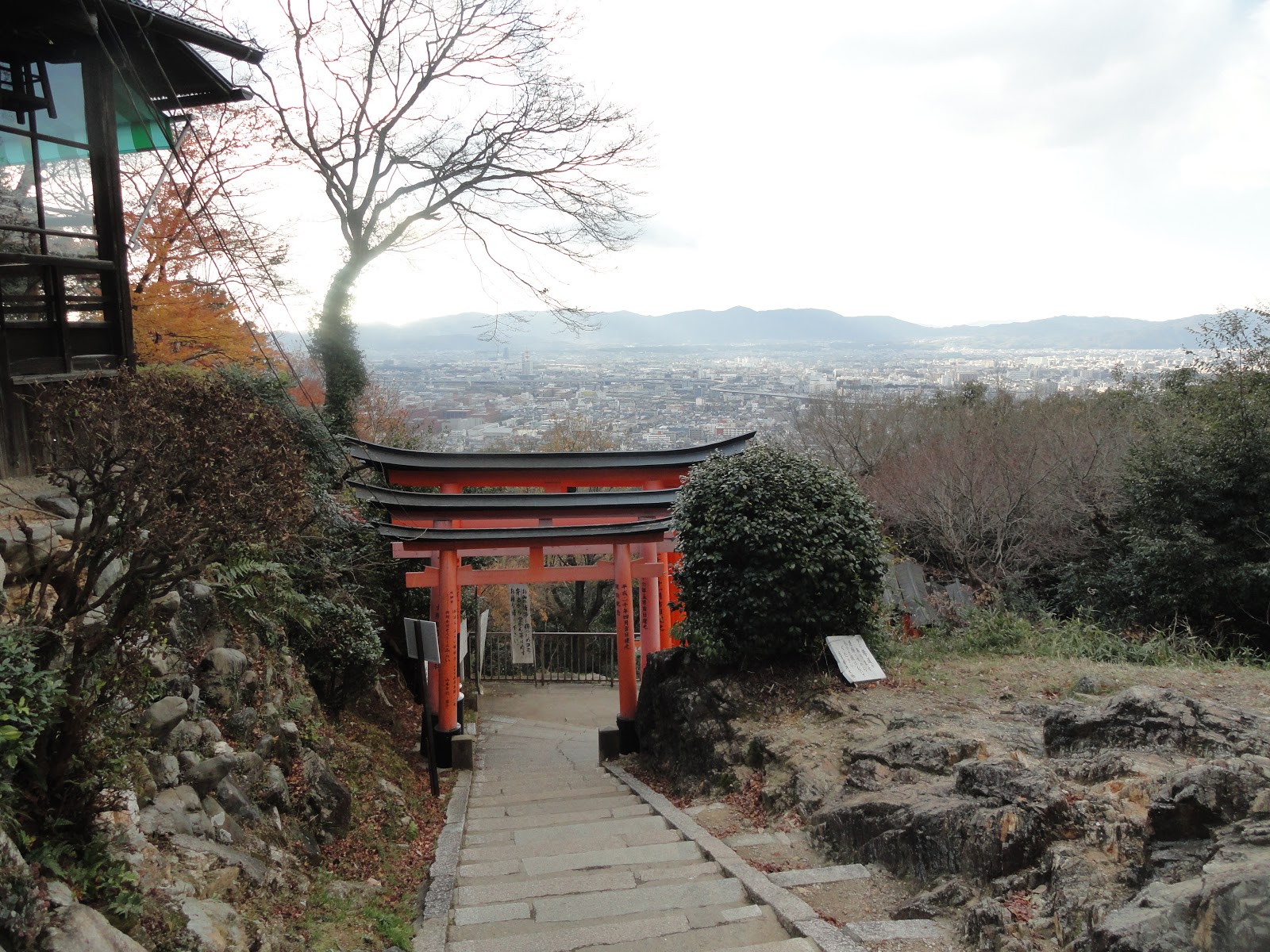
Our first stop was the Fushimi-Inari-Taisha Shinto shrine, which was one of the most visually interesting of the many shrines we viewed.  It sits at the base of a mountain and thousands of red torii (shrine gates) line the paths stretching up the slopes to the rear of the complex.  Dozens of stone foxes adorn the shrine.  They are considered the messengers of Inari, the god of cereals, and the key seen in their mouths is for the rice granary.  According to Japanese folklore, the fox is a mysterious figure capable of possessing humans, usually entering under the fingernails.  The grounds are also home to dozens of graveyards and individual shrines.  Since it was only a few blocks from our ryokan, we made two visits here, one our first night and the other on the last day.


If anyone can explain the meaning of the red bibs to H, she would be grateful.




Strings of tsuru, folded origami cranes, line the shrine walls and also give H the heebie-jeebies. For those who don't know the story, Japanese tradition (especially that of Hawaii's Japanese) requires brides to fold 1001 cranes and for the finished work to be displayed at the wedding. This is to reassure family and friends that the bride has sufficient perseverance, diligence and patience to make the marriage successful. The groom of course has nothing to prove. Instead of the traditional ropes of cranes, H decided to scatter them across our wedding and reception site (T's parents home place).


His Mom picked cranes out of her flower beds for months after.

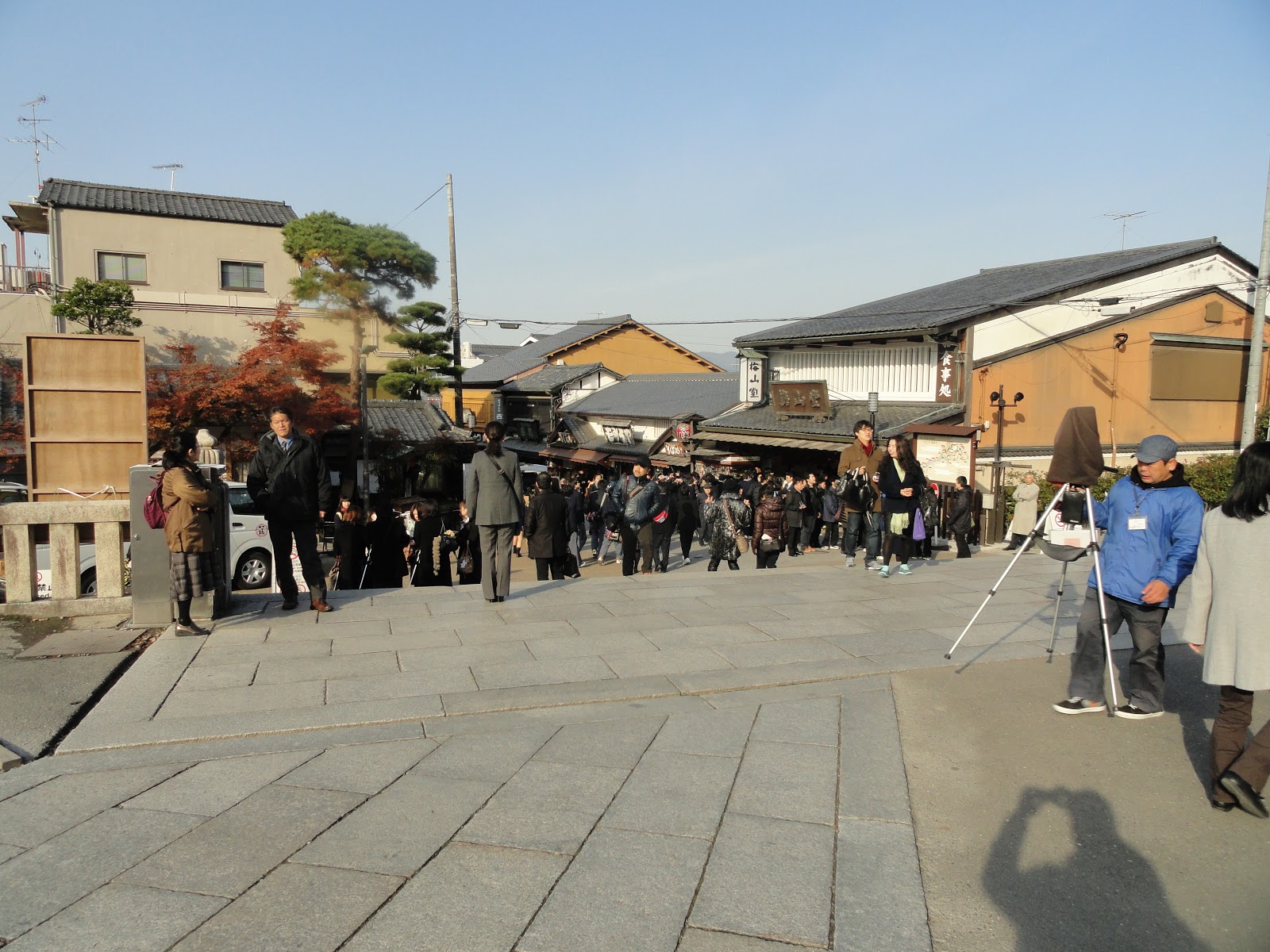
Our next major stop was Kyomizu-Dera, a Buddhist temple sitting on a commanding position above the city.  The temple was first established in 798, although the current structures date from the 1600s.  Lonely Planet calls it Kyoto's "spiritual heart and soul."  We would agree that it is an impressive structure, with lovely buildings, fascinating architecture, beautiful grounds, and great view, but the crowds took some of the spiritual nature of the visit away.   The street leading up the temple was packed with tourists, small shops, and restaurants.  The grounds too were loaded with tourists like us, plus tons of giddy Japanese teenagers there to buy a prayer plaque to assure success in romance and others sipping from the Otowa-no-taki spring where the waters are supposed to bestow health and long life.


Random rabbit dude at Kiyomizu-Dera.  Made T think of the character Hazel from Richard Adam's classic Watership Down.

From Kiyomizu-Dera, we walked the streets along the base of the Higashiyama (Eastern Mountains), taking in the sites, including young ladies dressed in traditional clothing, monuments to fallen soldiers and the guardian of their cemetery, rickshaws pulled by young men (boy, were those guys impressive!), massive temples, secluded "urban" gardens, burial sites for long-dead emperors, and ancient moss-covered trees.


H in heaven at a store devoted to her personal good luck charm, Totoro.


A real tsuru in a random pond in a random garden.


Oni (ogres) dot the rooftops.


Some Emperor's resting place.


For lunch we stopped at a bento (boxed lunch) hole in the wall. It was the first time H has had a bento made to order and it was delicious.

 The final temple stop was the grand Ginkaku-ji (Silver Pavilion). Although the grounds were indeed lovely, H was crestfallen when she realized that the Silver Pavilion isn't silver at all. In a way, it like much of the trip for her ... realizing how little she understands about her own culture.


Our first day in Kyoto ended with an evening spent in Gion, the entertainment district of the city.  Lonely Planet describes it as a bit drab during the day, but it was certainly a lively place at night, well-lit and full of people.  Indeed, many of the restaurants were full, but we managed to find a couple of nice places along some of the numerous alleyways to enjoy a drink and a sampling of the local cuisine.


Our last stop was to an Izakaya restaurant. Similar to tapas bars, these are places where alcohol is the primary draw and food comes in appetizer portions. While the food was good, what really got us interested was the replacement of wait staff with small touch screen menus that transmitted our orders wirelessly. We probably ordered more than we needed to because it was so fun touching the screen and watching the food appear.


The Gion Kabuki Theater.


Monday, March 28, 2011

Sunday Supper Series #10, or how to satisfy two country boys with Japanese comfort food

 
Last night we had a dinner guest, another son of the south. I decided to make Japanese diner fare, and in honor of the two of them I even broke out the deep fryer. It used to belong to T’s Mom, but we somehow ended up with it. Dinner was excellent, albeit a little chaotic towards the end. But I didn’t hear any complaints.

Menu: Homemade pork gyoza (dumplings), katsu curry (tonkatsu with beef curry), spinach gomae, rice.

There was a record number of Polyface meats on the table. Ground pork in the gyoza, beef in the curry and pork tenderloin for the katsu. Our dinner guest spends most weekends on his family farm in KY and we discussed the merits of small-scale farm grown meat. He shared a story about the challenge he faced recently when he was looking to buy some piglets. It seems the diversity has gone out of the nation’s hog supply. What used to be available in terms of different breeds, and here he went on with a list of quaint pig breed names of which the only thing I can remember is their color, black, black spotted, brown, etc…are no longer available. What is available now is a standard, genetically modified breed of pig that builds muscle in exactly the right (in economic terms) places, doesn’t build much fat and builds up very fast. This is the reason why most pork on the market is the shade of the bottom half of your fingernails rather than the deeper pink more akin to veal, and why most pork is tough, dry and tasteless and needs to be "enhanced" with chemical seasonings and tenderizers. The fact, sad but true, is that the flavor and tenderness of pork has been deliberately bred out of it by the desire of pork growers to have consumers latch onto it as the other lean, white meat.

Katsu curry is a standard of any reputable Japanese restaurant. There are some Japanese restaurants completely devoted to curry, and if you find one, go in and grab a table immediately, even if you have just eaten. In actuality, it is more akin to what we would think of as a stew, with a definite curry aroma and flavor. You can buy the curry seasoning “blocks” in tidy boxes, or you can make your own with “oriental curry powder” tins available at most Asian markets. I went the curry powder way as I think it tastes just as good and is probably healthier. I used Polyface chuck roast, which is such a flavorful and tender cut when cooked slow and long. I did the curry in my slow cooker, leaving it in the basement first and then out in the porch later in the day to avoid having the house reek of stale cumin odors for a week or longer. The first six hours was just the browned meat, curry powder, onions, garlic, ginger, some tomato paste, sugar, shoyu (soy sauce) and beef broth. Then I added chopped potatoes, pearl onions and carrots for two additional hours. Eight hours in the slow cooker was just about perfect. I made a lot, to last us through the better part of the week.

I went online for a new gyoza (dumpling) recipe to try. And although I have never made dumplings before using this method, this time I cooked the filling before forming the dumplings. This is both good and bad. Good because it allows you to adjust the seasoning perfectly before it is too late (usually what I do is take a bit of the filling and microwave it to determine flavor balance, but even this is not ideal). Bad because it is cooked and therefore okay to nibble on as you are standing there filling the wrappers. From the comments I got from the men, I think this recipe was a definite success. 


For some reason, I have never made gyoza, or jiaozi or shao mai (Chinese dumplings), that have not been delicious and appreciated. It is as if the work and time that goes into forming them one by one casts a magical aura of culinary goodness and satisfaction around each one. And on the other hand, although I come home with a different brand of frozen dumplings every time I go to the huge Korean and Chinese markets in our area, I have yet to find one that satisfies me as much as mine do. Shamefully biased, I know.


The cooked filling, made of Polyface ground pork, Napa (won bok) cabbage, carrots, green onions, garlic, ginger, soy sauce, mirin, seasame oil and egg. 


Wrapping in action. 

Déjà vu from last week’s gnocchi isn’t it? Again, one tray went into the freezer and the other  is now a thing of the past. 


And all cooked up on the dining room table next to my now stain-free springtime table runner.

The gomae is most often seen on the menu of Japanese restaurants as "spinach sesame salad." It is super easy to make. Blanch fresh spinach, then rinse and chill it. Grind about 1/4 cup toasted sesame seeds in mortar and pestle, add it to a bowl with a few tablespoons of shoyu, a few tablespoons of dashi (Japanese fish broth, I use instant stuff) and a scant teaspoon of sugar. Balance your flavors, wring out any liquid from the cooled spinach and coarsely chop it. Add it to the sauce and mix well. Balance the flavors again and chill. 

I figured that since T is not a fan of greens, our guest would likely not be either and I would end up eating it all week. Stupid and shallow thinking on my part. After we had left the table, our guest was still sitting there, eating the spinach straight from the bowl with his hashi (chopsticks) like a good old fashioned Japanese man until it was almost gone. It was very gratifying. 

Once the basketball game was over, the men migrated upstairs with what gyoza was left (not a whole lot) and stood around the deep fryer. As good country boys of the south it probably brought comfort to them at some deep, subconscious level. 


The Polyface tenderloin was cut up into thick slices and salted, then dredged in flour, dipped in egg and then pressed into panko, Japanese bread crumbs. Into the fryer it went and as soon as it came out we sat down, because we all know that deep-fried food is best the moment it hits the plate. 


We were in such a rush to eat it while it was hot that I didn’t even properly set the table. It was a haphazard free for all, as you can see. Although I did remember to take my precious $2 table runner off before curry sauce got flung all over it. See what I mean by a lot of curry to eat this week?


Here is my plate. Definite comfort food at its best.

Our guest brought dessert. Pumpkin pie and a lime cheesecake made from an old-timer recipe. I love lime desserts ant this one did not disappoint. Not that sweet, but it sure was filling. It put me right to sleep with a smile on my face.